
Bus Crowd - Traffic Jam
Hyper Surfer GamesCasual
4.1141.00 Reviews
- Version
- 1.2.2
- Installs
- 5.00M
- Age Rating
- Everyone
Screenshots
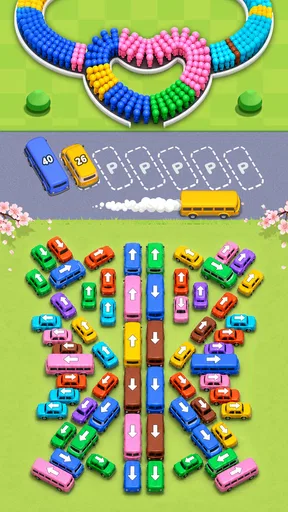
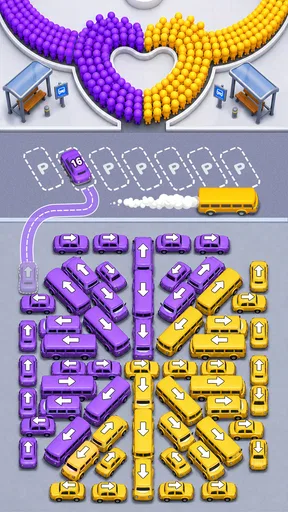
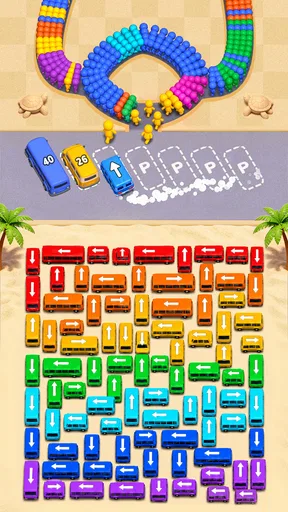
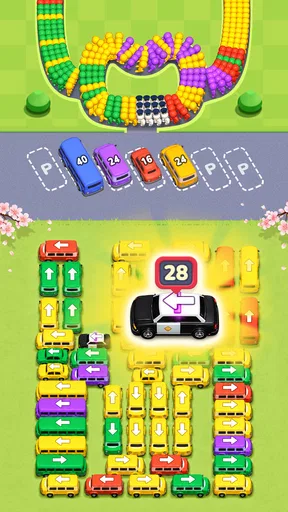
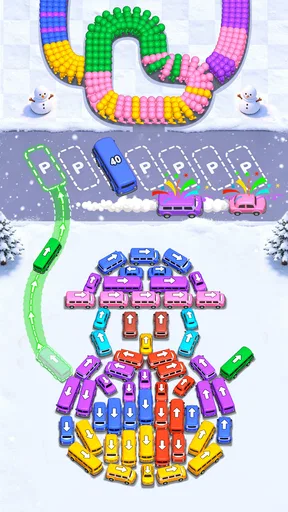
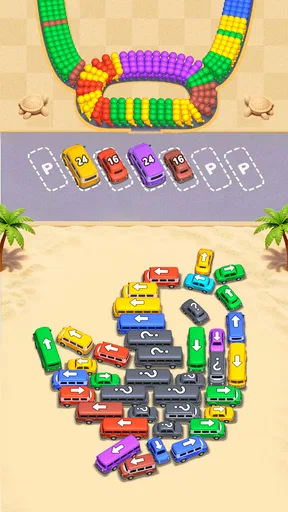

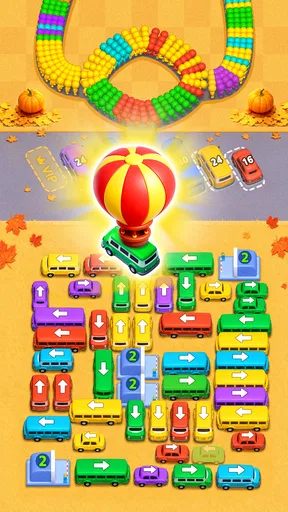
Our Review of Bus Crowd - Traffic Jam
 Analysis by Appyee
I approached Bus Crowd - Traffic Jam as a quick casual game rather than something meant to dominate an entire evening. Its basic appeal is easy to understand: you look at a crowded bus puzzle, study the available moves, and try to create a clean route through the mess. The colorful presentation makes the board approachable, but the interesting part is deciding which move will open space and which move will quietly make the situation worse.
That makes it a natural fit for short breaks. I can imagine playing it while waiting for an appointment, taking a pause between tasks, or winding down without committing to a long story or complicated control scheme. At the same time, it is not simply a game of tapping the most obvious object. The better results come from slowing down, reading the whole arrangement, and treating each move as part of a sequence.
Developed by Hyper Surfer Games, this free casual title is aimed at an Everyone audience and supports Android devices running version 8.0 or later. It has reached over 500 thousand installs and holds a 4.4 average from around 700 ratings, which suggests that its straightforward puzzle idea has found a reasonably broad audience. The current version is 1.1.3, and optional in-app purchases range from $1.99 to $99.99 per item.
What the first few minutes feel like
The first useful thing to know is that the game’s challenge comes from order, not speed. When the screen is crowded, my instinct is to make the move that looks immediately available. That is often the wrong habit. A bus or passenger arrangement can appear to offer several choices while only one of them preserves enough room for the next step. The visual style invites quick interaction, but the puzzle rewards a more deliberate glance before touching the screen.
I found the colorful design helpful during the opening stages because it separates the important elements without making the board feel intimidating. The visual clarity is especially valuable for a first-time player who is still learning what can move, what is blocked, and how a successful sequence develops. Rather than needing a tutorial packed with terminology, I could learn by watching how one action changed the rest of the layout.
That simplicity is also the game’s main limitation. Players looking for a deep strategy system, a character-driven campaign, or a competitive multiplayer experience should adjust their expectations immediately. This is a focused puzzle game built around clearing traffic-like arrangements. Its pleasure comes from solving the individual situation in front of me, not from building a large collection or mastering a complicated set of abilities.
Compared with a typical match-three game, the experience feels less dependent on chasing combinations and more dependent on planning space. Compared with a classic block puzzle, it has a more recognizable traffic theme and a stronger sense of movement through a jam. Those comparisons matter because they explain who will enjoy it: I would recommend it to someone who likes compact visual problems, but not to someone who needs constant action or a very different challenge in every session.
Starting without overthinking the install
Getting started should feel uncomplicated for most compatible Android users. The game is free to install, and the Everyone rating makes it suitable for a broad audience. I would still treat the purchase system as something to notice early: optional items are available across a wide price range, so a family sharing a device should agree on purchase habits before handing the game to a child.
My advice for the first launch is simple: do not rush through the opening boards just because they look easy. Use them to identify the game’s visual language. Pay attention to which spaces are genuinely open, which vehicles or groups are preventing movement, and whether a move creates a new route or merely shifts the blockage. This small adjustment makes later puzzles less frustrating because I am learning the logic instead of relying on lucky taps.
A useful first-session routine is to play with the sound and visual pace that feels comfortable, then stop after a few puzzles if the board begins to blur together. Casual games are at their best when I keep enough attention to notice patterns. If I play while distracted, I am more likely to blame the puzzle for a mistake that came from not checking the next two moves.
The game is also a better choice for short, repeatable sessions than for uninterrupted marathon play. Its format makes it easy to pick up and put down, but that does not mean every player will want to continue for a long stretch. If you prefer games that provide a large map, a long narrative, or a clear sense of character progression, this compact structure may feel limited rather than relaxing.
How I reached the first meaningful success
My first satisfying improvement came from changing the way I scanned the board. Instead of asking, “What can I move right now?”, I asked, “Which move will give me the most useful space afterward?” That question is more practical because a legal move is not automatically a good move. When several options appear possible, I look for the one that removes a bottleneck and keeps the remaining paths readable.
Another helpful habit is to identify the most constrained part of the arrangement before acting. A piece with only one apparent exit deserves more attention than a piece that can move in several directions. If I clear a flexible element first, I may leave the real obstruction untouched. If I deal with the narrow route early, the rest of the puzzle often becomes easier to interpret.
I also try to pause after every major change rather than tapping repeatedly. The board can look more open after a successful movement, but the new arrangement may require a completely different plan. That pause is not wasted time; it prevents a good move from being followed by an automatic bad one. For a first-time player, this is probably the most reassuring lesson: success comes from observing the changed position, not from reacting quickly.
When I get stuck, I avoid restarting immediately. I first retrace the last few decisions and look for the moment when I reduced my own options. This is a useful way to learn the puzzle’s rhythm, and it makes failure feel informative instead of random. Restarting has its place, especially when the board is clearly boxed in, but reviewing the mistake helps me recognize the same trap later.
The most non-obvious strength here is how much the game benefits from visual housekeeping. I mentally separate three things: the move that is available, the move that is safe, and the move that is necessary. Those are not always identical. A safe move may preserve the board without solving the main blockage, while a necessary move may look less attractive because it does not produce an immediate opening. Thinking in those terms gave me a more reliable path to a win than simply following the most colorful or prominent object.
Where new players commonly get confused
The crowded presentation can make the game seem more chaotic than it really is. When several buses and routes overlap visually, I sometimes focus on the nearest object instead of the central obstruction. The cure is to scan from the edges inward. First I check where movement can actually end, then I trace backward to see what is occupying that route. This reduces the temptation to make a move just because it is visually obvious.
Another source of confusion is assuming that an open-looking lane will remain open. A move can create temporary breathing room while also placing another element in a worse position. I therefore treat every newly opened area as a possibility, not a guarantee. Before committing, I check whether the next piece will still have somewhere useful to go.
It is also easy to confuse progress with activity. A board may change a lot without becoming closer to completion. If my moves are only rearranging the crowd, I stop and search for the piece or route that is limiting everything else. This distinction is important for players coming from fast arcade games, where constant input often feels productive. Here, fewer deliberate moves are usually better than many harmless ones.
Some players may wonder whether they need to spend money to enjoy the core experience. My view is that the game should first be judged on its free puzzle loop. Purchases are optional, but the listed items can cost from $1.99 up to $99.99 each, so I would not treat the purchase screen casually. If you want a completely purchase-free environment, especially on a shared family device, establish that boundary before playing.
The age rating also answers an important practical question: the game is marked Everyone, so it is designed for a broad audience. Still, “suitable for everyone” does not mean every person will find it equally enjoyable. Younger players may appreciate the colors and direct objective, while older puzzle fans may want more complexity than the compact format provides. For children, I would focus less on winning every board and more on encouraging them to explain why a move creates room.
Small techniques that make later boards calmer
One technique I kept returning to was preserving flexibility. If two pieces can both use a route, I avoid blocking that route with the piece that has fewer alternatives unless the move solves a larger obstruction. This sounds minor, but it changes the board from a chain of guesses into a set of manageable choices. I do not need to predict the entire solution; I only need to avoid closing the useful options too early.
A second technique is to look for dependency chains. Sometimes one movement matters because it allows another movement, which then exposes the actual exit. I mark that mentally as “A enables B,” rather than judging A by its immediate visual result. This is especially useful when the first move appears unhelpful. The right opening action may be a setup move whose value becomes clear only after the next change.
A third practical tip is to use the end of a session as a learning checkpoint. If I solved a board by luck, I ask what made the final route possible. If I failed, I identify whether I ran out of space, chose the wrong bottleneck, or acted before checking the new layout. That short reflection improves my next attempt more than simply replaying at the same speed.
These habits also reveal a trade-off. The game is accessible because it does not bury the player under complex controls, but that accessibility means the challenge must come from board reading. Players who enjoy discovering an efficient solution can find surprising depth in a simple-looking puzzle. Players who want elaborate systems may instead feel that the same central idea is being revisited without enough variety.
Who should make room for it, and who should skip it
I would recommend Bus Crowd - Traffic Jam to anyone who likes visual organization puzzles and wants something that can be played in short bursts. It suits commuters, casual players, and people who enjoy solving a problem at their own pace. It is also a reasonable introduction for someone who normally avoids puzzle games because the theme and objective are easier to understand than an abstract grid.
I would be more cautious recommending it to players who dislike restarting a puzzle after one poor decision. The game’s planning emphasis means that an early mistake can affect everything that follows. That is satisfying when I understand the cause, but irritating when I want a forgiving experience with constant forward motion. Players who prefer word puzzles, number puzzles, or match-based scoring may also find the traffic arrangement less appealing than their usual format.
Against ordinary casual alternatives, its strongest point is the combination of approachable visuals and spatial decision-making. Its weaker point is that the central loop is narrow. A match-three game may offer more immediate variety through combinations, while an endless runner may provide a stronger sense of reflex and momentum. This game is the better choice when I want to think briefly and clearly, not when I want spectacle, speed, or a long-term collection goal.
In an everyday scenario, I would use it during a ten-minute break after finishing a task. I could complete a few puzzles, put the phone away, and return later without needing to remember a story or manage a large inventory. If I were already tired, I would play more slowly and stop as soon as I began making automatic moves. That keeps the experience relaxing rather than turning a small puzzle into an unnecessary source of frustration.
My final take after learning its rhythm
The best way to enjoy Bus Crowd - Traffic Jam is to treat each move as space management, not button pressing. Once I adopted that mindset, the colorful traffic scenes became clearer and the game felt more rewarding. The first success is not just clearing a board; it is recognizing why one route remained possible while another disappeared.
Hyper Surfer Games has kept the concept approachable, and the free entry point makes it easy to test whether this kind of puzzle suits you. The broad age rating and modest device requirement also make it a practical choice for many Android users. Just remember that optional purchases exist, and the higher end of the listed purchase range is substantial enough to deserve attention before sharing the device with someone else.
My recommendation is positive but specific. Choose it if you want colorful, bite-sized traffic puzzles that reward patience and careful sequencing. Skip it if you need a deep campaign, fast reflex action, or major genre variety. For a first-time player, the path is reassuring: install it, study the opening board, make one move that creates useful space, pause to read the new position, and build from there. That simple rhythm is where the game makes its strongest impression.
Privacy and Permissions
See what permissions an app requests and how it handles your data.
- Wi-Fi connection information
- view Wi-Fi connections
- Other
- view network connections, full network access, control vibration, prevent device from sleeping, Google Play license check
Verdict
Strengths of Bus Crowd - Traffic Jam
- Simple controls make the game easy to pick up quickly.
- Short levels are convenient for quick gaming sessions.
- Colorful visuals make the crowded scenes easy to follow.
- Increasing difficulty keeps later puzzles more engaging.
- Offline play is useful when you have no internet connection.
Limitations of Bus Crowd - Traffic Jam
- Some levels can feel repetitive after extended play.
- Progress may depend heavily on watching ads or waiting.
- Crowded layouts can occasionally make moves hard to judge.
- The game offers limited variety beyond its core sorting puzzles.
- Mistakes may feel frustrating when a level requires precise timing.
Similar Picks in This Category
View All
My Talking Angela
Outfit7 Limited4.2

My Talking Tom
Outfit7 Limited4.3

Pou
Zakeh4.2

My Talking Tom 2: Pet Game
Outfit7 Limited4.3

Candy Crush Saga
King4.6

Bridge Race
Supersonic Studios LTD4.1
Frequently Asked Questions
What is Bus Crowd - Traffic Jam and how is the game played?
Bus Crowd - Traffic Jam is a casual puzzle game focused on organizing passengers and moving buses through increasingly crowded traffic situations. You generally need to match passengers with the correct bus colors, clear paths, and manage limited spaces without creating a blockage. Each level becomes more challenging as more vehicles, passengers, and obstacles are introduced, requiring careful planning rather than simply tapping quickly.
Is Bus Crowd - Traffic Jam free to download and play?
The game can generally be downloaded for free on supported Android or iOS devices, but free gameplay may include advertisements and optional in-app purchases. These purchases can sometimes provide hints, extra moves, boosters, or other conveniences. Before downloading, it is worth checking the store listing for the latest pricing, available purchase options, and whether the version offered in your region includes advertising.
Does Bus Crowd - Traffic Jam require an internet connection?
Many of the basic puzzle levels may be playable without a continuous internet connection, which makes the game suitable for short sessions while traveling or when mobile data is unavailable. However, certain features may depend on connectivity, including advertisements, cloud saving, events, updates, leaderboards, or purchases. Offline availability can vary between versions, so you should not assume every feature will work without internet access.
Is Bus Crowd - Traffic Jam suitable for children and casual players?
Bus Crowd - Traffic Jam is designed around simple controls and easy-to-understand visual objectives, making it accessible to casual players and older children. Nevertheless, later puzzles can require patience, planning, and repeated attempts. Parents should review the age rating and privacy information because advertisements, optional purchases, and online features may be present. Younger players may also need supervision to avoid accidental purchases.
What are the main advantages and possible disadvantages of Bus Crowd - Traffic Jam?
The main advantages are its straightforward controls, short level format, colorful presentation, and gradual increase in puzzle difficulty. It can be relaxing for quick play sessions while still offering moments that require strategic thinking. Potential disadvantages include repetitive gameplay after extended sessions, frequent advertisements in some versions, and difficulty spikes that may encourage the use of hints or boosters. The overall experience can also depend on your tolerance for mobile-game monetization.
Play our best games!


